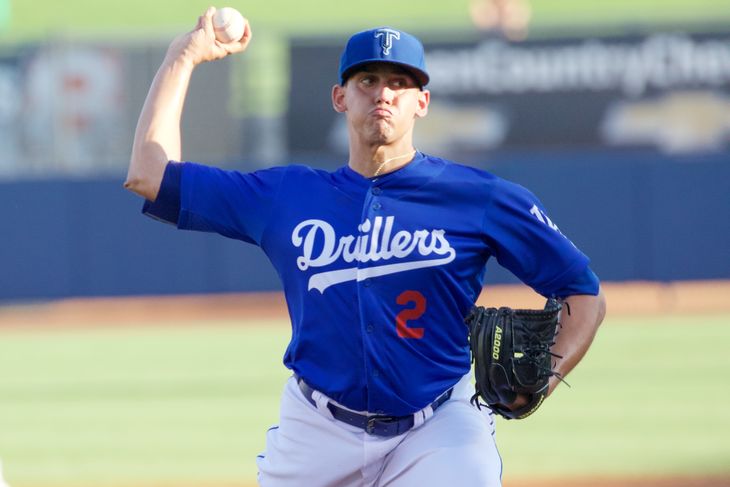
(Editor’s note: TBPC would like to welcome aboard another new member to the writing team, Jeremy Davis. Jeremy will primarily be conveying his own hands-on, personal perspectives in relation to the Tulsa Drillers, as well as occasional reflections involving the other minor league affiliates. Be sure to check back often, as Jeremy hopes to frequently publish many more insightful articles.)
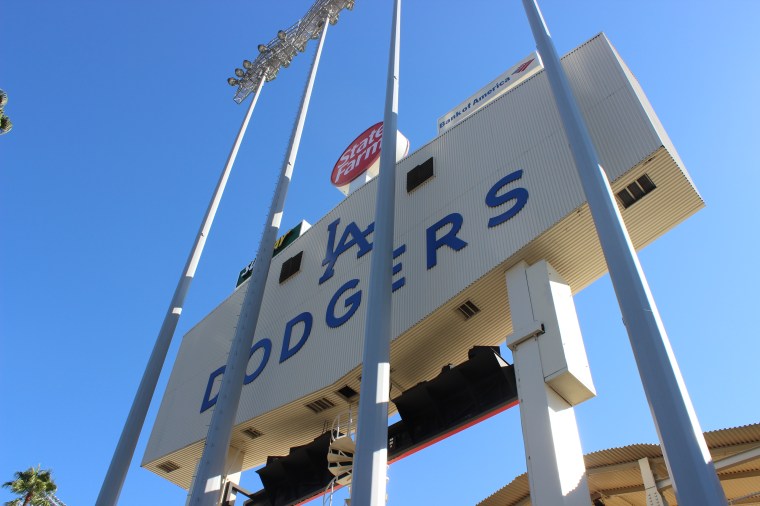
In 2001, I made a tough decision in life… I moved away from my family and 1,539 miles away from my piece of heaven. Dodger Stadium was a place I spent many a summer night with my friends out in the bleacher seats, eating Dodger Dogs and cheering on the Boys in Blue. My new location was deep in the heart of Cardinal territory and boy was it strange. I was a blue dot in a sea of red.
I remember the day I found out that my Dodgers had changed their AA and AAA affiliate to be within a few hours of me. I checked to see if we could swing season tickets, could we move there ASAP and how many times they would be in Springfield, Mo. The answers were no, not right now and 18 games. 1 out of 3 wasn’t bad, right? We decided to become partial season ticket holders to the Springfield Cardinals with seats behind the visitor’s dugout for every game the Tulsa Drillers were in town.
Opening weekend we took a road trip to Tulsa for opening night at OneOK Field. Opening night was full of everything picture with Corey Seager, tweet on the scoreboard and a nice Drillers win. The next night it was on to OKC for the next game. Kiké, Bolsinger and Dodger dogs. My wife is no rookie when it come to my Dodger fandom but this made it all more apparent my love for the team. Two wins, great food and amazing memories.
That first season in Tulsa was full of highs for me with very few lows. Every game I left the park with a smile on my face win or lose because of the experience. Whether a game ball signed by Julio Urias, being photobombed by Nate Samson or tickets left by a player there was always something new at every game. As the season went on I became a familiar face for the Tulsa Drillers players and coaches when they were in town. That first season we collected signed balls, bats, hundreds of pictures and player interactions that will last us a lifetime. Oh and we met Tommy freaking Lasorda. With season 2 on the horizon, I decided it was time to share my adventures with all and hopefully pass along some souvenirs.
There’s another new coach I don’t know much about in the Dodgers‘ dugout. Bob Geren will be joining rookie manager Dave Roberts as bench coach. Geren is filling the role left by Tim Wallach, who followed Don Mattingly to Miami.
Geren is a former catcher who spent 10 years in the minor leagues before making his debut with the New York Yankees in 1988. He stayed with the Yankees for four years, spent a year in the minors with the Pawtucket Red Sox, then played his final year with the San Diego Padres in 1993.
Geren has coached his way through the ranks, starting in the Red Sox organization at both the Rookie and Class A levels, before joining the Oakland A’s to manage their Triple-A team in Sacramento. He was promoted to bench coach for the A’s in 2002, where he remained through 2006. On November 27, 2006 he ascended to manager in Oakland, where he guided the A’s to their first losing season since 1998.
His time with Oakland was rocky — he received an extension on his contract, but his managing style was questioned after several players voiced their displeasure. Former A’s reliever Huston Street called him the “least favorite person I have ever encountered in sports.” He was fired on June 9, 2011.
On October 14, 2011 he was hired to be the bench coach for the New York Mets. Geren would go on to spend four years in New York, which included a run to the World Series last season. In December, he was hired by the Dodgers to be bench coach, after having interviewed for the managerial position in early November. Geren and his wife are from California, and have stated that the favorable location had weighed a lot in his decision to come to Los Angeles.
Geren has many good things to say about manager Dave Roberts. In an interview with Robert Pace of Fox Sports, Geren said, “His (Roberts) enthusiasm is infectious, his personality is off the charts. He’s a great pick, just a great choice.”
Geren also feels that he can be a good teacher for the younger Roberts, and that they can lean on and learn from each other.
Hearing that he’s been called the “least favorite person” that someone has met in sports in concerning for sure, but his years of experience and his willingness to be open to the ideas of the front office should provide a good sounding board for Dave Roberts as they strive to take the Dodgers deep into the postseason.
Los Angeles Dodgers starting pitcher Alex Wood throws during the first inning of a baseball game against the Cincinnati Reds, Tuesday, Aug. 25, 2015, in Cincinnati. (AP Photo/John Minchillo)
Nowadays, typical fans of the Los Angeles Dodgers never seem to be satisfied. Understandably, it is tough to blame them, being that it’s been 27 years and counting since the team’s last World Series championship.
And the same typical fans can sometimes be a bit delusional — as we all very well know. Usually, it’s the constant criticism of the front office not spending more money, trading away a player who was a fan favorite, or not making that blockbuster deal just moments before the trade deadline. The psychological progressions and maddening obsessions eventually lead to the fans’ own personal greed and uninformed opinions coming to light, instead of realizing what’s best for the team in the long run.
The same can be said for Dodgers’ pitcher Alex Wood, at least up until several weeks ago. The moments after the team signed free agent pitchers Scott Kazmir and Kenta Maeda, the unenlightened fans began to work their glamour, calling for an immediate trade, only because the starting rotation was now overloaded with players who were more talented than Wood, and the bullpen already had two left-handed pitchers and two long men.
The fans had somewhat of a right to be critical, though, as Wood’s time in a Dodgers uniform after being acquired from the Braves resulted in a bit of a roller coaster ride.
His decreased velocity led to a plummeting strikeout rate. In 2014, he flaunted a respectable 8.91 K/9, while his overall numbers last year produced a mere 6.60 K/9. His 116 ERA- and 106 FIP- for the Dodgers were well below his career averages. And the home and away splits were also extremely noticeable.
Wood made five starts at Dodger Stadium, and all five were quality starts, reeling out a 2.41 ERA, a 3.25 FIP, a 20.2 percent strikeout rate and a 4.1 percent walk rate.
On the road, however, Wood made seven starts after joining the Dodgers, and just one was a quality start, resulting in a 6.14 ERA, a 4.88 FIP, a 14.3 percent strikeout rate and a 10.7 percent walk rate.
And to boot, a pitcher with a fastball topping out at 89 mph, an extremely low arm slot and a very strange delivery is never overly appealing to the typical fan.
All that being said, it came to light about a week ago that Wood has spent his whole Dodger career playing with a bone bruise in his right foot.
LA Times beat writer for the Dodgers, Andy McCullough, was first to report the details of the injury on February 22. In his final game with the Braves, Wood rolled his right ankle on a play covering first base. A bone bruise developed in his foot, which pained him every time his foot landed when he threw.
Wood used almost the entire winter letting his foot heal, and once he was able to throw pain-free, began to polish and fine-tune his mechanics.
“I had already gotten into some bad habits mechanically,” Wood said. “So it was a long offseason full of trying to get back to where I needed to be.”
The news of Wood’s injury, coupled with the actuality of Hyun-jin Ryu‘s delayed return, left fans more forgiving and forced them to realize that Wood is much more valuable to the team than what they perceived originally.
As for the beginning of the season, Wood will more than likely slot into the fifth spot in the rotation, at least until Ryu is ready to return, which could extend into May.
It’s been a number of years since the Dodgers’ main starting rotation stayed healthy for the bulk of a season, and Wood will remain on alert to fill any need when an injury does occur.
Early estimates for the usage of Ryu were calculated at the 20-start and 150-inning range. No projections were given for Maeda; however, both Maeda and Ryu are accustomed to throwing once per week rather than every five days, which may leave another door open for Wood.
It could be easy enough to sculpt a potential six-man rotation, where Wood would pitch on Maeda and Ryu’s scheduled fifth day, stretching time between starts and giving Maeda and Ryu the required rest that was common in their homelands — a large enough role to warrant Wood a spot on the 25-man roster.
As for the future, so long as his numbers stay stable and consistent, Wood is more valuable to the club than many fans realize. Brett Anderson is signed only through the 2016 campaign, while Kazmir’s contract involves a potential opt-out after this season. Brandon McCarthy, who is expected to return at some point during 2016, is only signed through 2017.
In terms of team control, Wood will not be eligible for free agency until the year 2020, and has all three option years remaining on his contract — a scenario that is valued very highly by today’s front offices.
Nevertheless, utilizing an option and being sent to the minors for any length of time isn’t an alternative in Wood’s eyes.
“I’m going to be in the rotation,” he said. “That’s the plan. That’s the thing I hate about the offseason, about spring training. I’m more about action than about talk. I plan on being in the rotation. And I don’t plan on leaving.”
I’ll admit I didn’t know too much about Dodgers‘ new manager Dave Roberts when he was hired. I had a vague recollection of his steal in the ’04 ALCS that helped propel the Red Sox past the Yankees and into the World Series, and also that he had previously played for the Dodgers (’02-’04).
The first thing that I notice about him is his smile. Such a girly thing to notice, right? But from my armchair psychologist view, it says a lot. Sure, we saw Don Mattingly smile a lot during his time with the Dodgers. But in retrospect it always seemed strained to some degree. Maybe that’s just Mattingly’s nature. Roberts’ smile is huge and genuine. Being genuine surely can only help being a first time manager of an iconic baseball team.
Much of Roberts’ playing career was marred by injury. But he was excellent at manufacturing runs, which is something this Dodgers team can only benefit from after ranking 19th in the Majors in runs scored last year. More offensive output can only bolster the confidence of a pitching staff many have questions about, after Clayton Kershaw.
Roberts started out the season by reaching out to Yasiel Puig, and saying that they were starting with a fresh slate. He met with each player one-on-one at the beginning of spring training. Brandon McCarthy had some great things to say, according to Eric Stephen via Twitter
…I haven't heard a person who has a single bad word to say, which is somewhat rare. I think everybody is very excited that he's on board."
Maybe the most important aspect, though, is that he buys into and is aligned with the thinking of this front office. Roberts, along with new bench coach Bob Geren who previously was with the NL champion New York Mets, take into account the analytics and stats along with the old school thought. Mattingly never seemed to be comfortable with all of that.
Dave Roberts nickname is ‘Doc’, a play on his initials DR. Maybe he is just what the doctor ordered to finally get the Dodgers into the World Series.
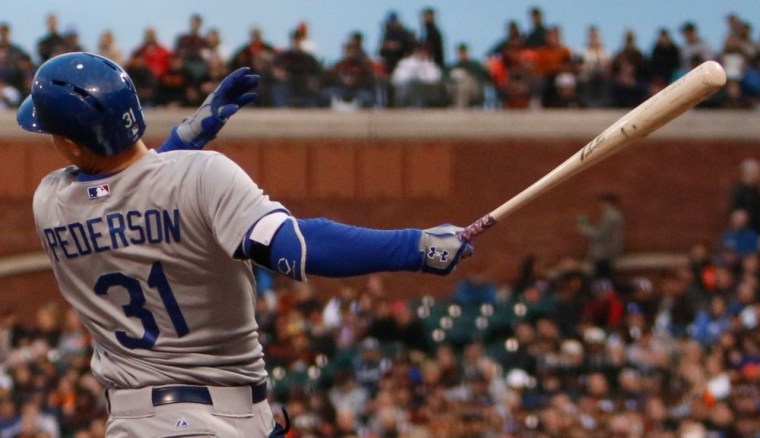
There was no secret that Los Angeles Dodgers‘ center fielder Joc Pederson intended on making adjustments to his swing over the months leading up to spring training.
Pederson has always worked hard in the winter. After a full season with Double-A Chattanooga in 2013, he played 34 games for the Cardenales de Lara in the Venezuelan Winter League. In 2014, after breaking several Pacific Coast League records with the Albuquerque Isotopes, he extended his year by playing 22 games with Leones del Escogido in the Dominican Winter League.
Following the 2015 season, rather than travelling abroad, Pederson decided to stay on the West Coast and spend time with both old minor league hitting coach Johnny Washington and new Dodgers’ hitting coach Turner Ward.
Having succeeded immensely at almost every level at which he’s competed, and despite putting in extra work almost every winter, it’s been a long time since Pederson has found himself needing to make adjustments in his swing.
“I’ve been working hard this offseason to work on becoming a better hitter, hitting more line drives and using the whole field,” Pederson said. “I think I’m gifted that the power will be there. I’m just trying to hit balls on the barrel.”
As indicated early in spring training, Pederson’s swing is much more compact. Gone is the heavy thump of his front foot at the end of his leg kick. And the twisting of his right ankle once the foot lands isn’t as exaggerated as it was last season.
Perhaps it was Ward’s arrival that led to Pederson’s new and fresh approach to hitting. After all, there were subtle hints last season that Pederson had experienced differences of opinion with former hitting coach Mark McGwire.
Ward, who was a minor league teammate of Pederson’s father, Stu, likes what he sees in terms of Pederson’s progress. He continues to assist Pederson both in the cages and on the fields at Camelback Ranch.
“He’s going to be a pure hitter. He is a pure hitter. But he had to go through some stuff to kind of help him recognize some things he needed to work on,” Ward said of Pederson.
In the first half of 2015, Pederson had an .851 OPS, a 137 wRC+, and was chosen to represent the Dodgers in the All-Star Game. He hit his 20th home run on June 29, and was actually an early favorite for the National League Rookie of the Year award.
He struggled in the second half, though, posting a .617 OPS and 79 wRC+. He hit .177 and had a .319 OBP. By the time the playoffs rolled around, Enrique Hernandez was getting the majority of playing time in center field.
Now equipped with a new swing, Pederson hopes to revive the success he experienced early last season.
“Baseball’s a crazy game,” Pederson said. “But last year is old news, you know. I don’t even have any thought about last year. I learned from it. I gathered my information and I’m moving forward.”
Upon being hired Dodgers’ manager, Dave Roberts reached out to Pederson almost immediately to discuss swing mechanics, reinforcing pitch recognition and how to go about developing a better swing path to the baseball. Roberts also deliberated the psychological aspects of hitting with Pederson.
Roberts emphasized how he was always impressed with Pederson’s defensive ability in the field. In terms of offense, Roberts, like Ward, is pleased with the way Pederson looks early in camp.
“Joc has been consistent defensively and continued to get better defensively,” Roberts said. “On the offensive side, he and Turner (Ward) and Tim Hyers, they’ve got a great rapport, and continue to keep that stroke clean and be consistent. There’s a little bit more comfort as he comes into camp this year than last year.”
Dodgers fans everywhere hope that Pederson’s progression continues through spring training, and that his new swing leads to less strikeouts and more line drives off his bat. In the back of everyone’s minds is the fact that the Dodgers still desperately need an effective leadoff hitter.
Pederson may fit the bill if everything falls into place properly.
And, in the fullness of time, it doesn’t hurt having his manager, who was once a very solid leadoff hitter himself, guiding and supporting him one-hundred percent of the way.
It seems like it happens every single year. This year, it just happened a little bit later. The Dodgers go shopping and sign a handful of scrappy, veteran, middle relievers to help fill out what projected to be an extremely young bullpen.
Ned Colletti was notorious for this. The winter of 2010-11 comes to mind in particular, when the former GM went on a spree in an attempt to re-invent the relief corps, signing a group of veterans that were either unrecognized or weary from many years of service. A few of the players in the haul included Matt Guerrier, Merkin Valdez, Roman Colon, Ron Mahay, Jon Huber, Oscar Villarreal and Mike MacDougal. Although Guerrier and MacDougal generated a bit of success, most were non-roster invitees who persevered through spring training only to be sent packing upon the arrival of Opening Day.
Assembling the 2014 bullpen was one of the chief factors in Colletti’s demise as general manager. Overall, everyone not named Kenley Jansen, Chris Withrow or J.P. Howell performed horribly. The Dodgers paid former closers Brian Wilson $10 million, Chris Perez $2.3 million and Brandon League $8.5 million. The team’s $30-plus million bullpen contained several high profile names, but significantly less talent than there should have been at that price.
While acquiring a few veteran players for minimal dollars who are willing to teach and share experiences is always beneficial, spending lavishly on a laundry list of high-profile, prominent headliners past their primes always proves to be detrimental in the end.
Last season sparked a few memories, as one commonly wondered if Colletti, now a senior advsior to team president Stan Kasten, played a role building the pen with his antiquated beliefs and philosophies. The 2014-15 NRI relievers included David Aardsma, Mike Adams, Ryan Buchter, Chad Gaudin, David Huff, Ben Rowen and Sergio Santos. Huff and Santos were able to contribute on very small scales, while the others migrated away from Los Angeles and either retired or pursued other opportunities.
The 2016 offseason had a feel for the first time in years that the youth of the Dodgers’ organization would shoulder the brunt of the relief duties. At one point, a deal for flame-thrower Aroldis Chapman seemed like it would elevate the bullpen to an elite level; however, the front office eventually used its best judgement and declined a surefire trade, leaving the impression that the existing corps would need to fend for themselves.
Ultimately, the Dodgers would make only three notable free agent signings in efforts to strengthen the bullpen — Joe Blanton, Louis Coleman and Jamey Wright. The Blanton and Coleman deals were both one-year, MLB contracts, while the Wright signing was minor league in nature with an invite to spring training.
Wright, a 19-year major league veteran, has pitched with 10 teams, including two separate stints with the Dodgers. He had no offers from other clubs after being cut at the end of spring training by the Rangers last year.
Coleman appeared in just four games for the Royals in 2015, allowing no earned runs. The bulk of his season was spent in Triple-A Omaha, where he recorded a 1.69 ERA in 38 relief appearances, striking out 63 and walking 23 in 64 innings of work. In parts of five seasons with Kansas City, Coleman has a 3.20 ERA in 152 games, all in relief.
After posting a 6.04 ERA in 132 innings with the Angels in 2013, Blanton retired and was out of baseball for the entirety of the 2014 season. He rediscovered his mechanics last year and settled in as a reliever with the Royals before being dealt to the Pirates for cash at the trade deadline.
Although Blanton projects to play an active role as long man in the bullpen, the true value of all three of these veterans goes well beyond the numbers. They have an opportunity to exhibit professionalism, share real game experiences, offer advice on workout routines and critique pitching mechanics — things that the young pitchers in the organization need to develop their own personal acumens.
This is the part of baseball where all the sabermetric analysis in the world has no value.
In the end, sometimes the few million dollars spent on contracts and the mediocre statistics should take a backseat to the valuable experience that these veterans possess, and most importantly, the desire and willingness they have to share with others on the squad.
After all, the youth in the Dodgers’ organization deserve nothing less.
When we last explored the projected starting rotation at Oklahoma City in December, the Dodgers’ big league rotation was trending towards being on the thin side, while the Triple-A rotation looked to be crowded. Now, with spring training upon us, things seem to have leveled out a bit.
Since our last analysis, the Dodgers bolstered their starting rotation by adding veteran lefty Scott Kazmir, as well as Japanese righty Kenta Maeda. Brandon Beachy was also brought back on another one-year contract, hoping to create depth for a rotation that currently projects to include four left-handed starters and one right-hander.
The Yasiel Sierra signing finally became official; and although he projects to be a potential middle-reliever in the bigs early in his career, he may see time as a starting pitcher in the minors, at least in the beginning of the season.
Joe Blanton was signed to a one-year deal last month to be utilized as a long man in the bullpen, which may affect the role of Carlos Frias early in the year. Frankie Montas, who was projected to see some time as a starter in the minors, was moved to the 60-day disabled list after having rib resection surgery.
All that being said, here’s a list of the potential pitchers vying for a rotation spot in Oklahoma City in 2016. Also included are the pitchers’ ages come Opening Day, the number of option years they have remaining and a brief commentary as to where they may begin the season.
Brandon Beachy – 29 years, no options
Mike Bolsinger – 28 years, one option remaining
Carlos Frias – 26 years, one option remaining
Zach Lee – 24 years, two options remaining
Ross Stripling – 26 years, all three options remaining
Yaisel Sierra – 24 years, all three options remaining
Jharel Cotton – 24 years, all three options remaining
José De León – 23 years, all three options remaining
Julio Urias – 19 years, all three options remaining
Although José De León and Julio Urias are arguably the two most talented pitchers on the list, neither is on the 40-man roster, and may not see big league action until rosters expand in September. De León is fully developed and is considered by many to be MLB-ready, while Urias likely needs one additional season on an innings count due to the fact that he’s still maturing physically. Barring injury, both should hold down spots in the Oklahoma City rotation for the majority of the season.
Jharel Cotton had been a starter most of his career, but was given an opportunity to relieve late last season when the Triple-A bullpen was very thin. He probably has the best changeup in the Dodgers’ entire system, and projects better as a starter due to the lack of velocity on his fastball (90-91 MPH). His breaking pitches are his best weapons, leading him to a 10.7 K/9 in almost 100 innings of work last year. Still, with the rotation being as crowded as it is and the bullpen on the thin side, Cotton may begin the season as a reliever.
Beachy and Mike Bolsinger will certainly be the first two to be called upon if the Dodgers need help. After returning from Tommy John last season, Beachy pitched 47 innings over 10 appearances at OKC. When given the opportunity in the bigs, he surrendered 10 hits and seven runs in two appearances. Bolsinger ended up contributing 109 innings over 21 starts for the Dodgers, compiling a 6-6 record with a 3.63 ERA and a 8.1 K/9. Both project to be the front-line starters for Oklahoma City.
Former first-round draft pick Zach Lee had a rough debut for the Dodgers against the Mets last July, but put up solid numbers in Triple-A over the course of the season. He compiled a 11-6 record while throwing 113 innings over 19 starts, which led to a 2.70 ERA and a 1.11 WHIP. He also likely fills a starting slot for OKC.
Ross Stripling returned from Tommy John and pitched 67 innings over 13 starts for the Tulsa Drillers last season. He was added to the 40-man in November to protect him from Rule 5 status. Stripling isn’t overpowering, but features a nasty arsenal of breaking pitches much like Bolsinger. Stripling has never thrown at the Triple-A level, and may begin the year at Tulsa just to make room for everyone else at Oklahoma City.
While considered to be MLB-ready by most scouts, the prudent avenue for Sierra would be to begin the year in the minors, if only for reasons of getting acclimated to his new country. Over five seasons in Cuba’s Serie Nacional, he went 16-21 with 25 saves and a 4.23 ERA in 131 games which included 25 starts. Sierra most likely starts the season at Tulsa.
Frias made 17 appearances including 13 starts for the Dodgers last season, hurling 77.2 innings to a tune of a 4.06 ERA. Blanton may command the role of long man early in the year for the Dodgers, but depending on the health and effectiveness of the remainder of the relief corps, Frias should see big league action at some point in 2016. As for the beginning of the season, he most likely gets the nod as long man and/or spot starter for OKC.
Depending on the health and progression of lefty starter Hyun-jin Ryu at the beginning of the season, Alex Wood could see time in the minors if the Dodgers’ rotation stays healthy, only because he’s one of the few that has options remaining on his contract. We do have a few ideas how this may play out, however; and we’ll be providing additional insight and commentary later in the week.
In light of everything discussed, we see things at Oklahoma City shaping up something like this:
OKC starting rotation: Beachy, Bolsinger, Lee, De León and Urias; with both Frias and Cotton in the bullpen
Stripling and Sierra beginning the year at Double-A Tulsa but rising quickly
If healthy, the 2016 Triple-A rotation may very well be the deepest and most talented that Dodger fans have seen in many, many years. Beyond that, the next wave of talent is beginning to blossom and shine in Single-A and rookie ball.
Right now, the Dodgers’ future seems to be extremely bright — at least on the pitching front.
(Editor’s note: TBPC would like to welcome Andy Lane Chapman to the writing team. Hopefully, Andy will tolerate the quirkiness of both myself and the blog site and continue to contribute many insightful articles in the future. Feel free to give her a follow on Twitter.)
When I first joined Twitter, I was told a few times by other Dodgers fans, that I was not a “real fan”. A “real fan” couldn’t possibly live outside California, let alone all the way across the country. Of course this is a load of bull, but allow me to tell you how I became a Dodgers fan that lives in Pennsylvania.
My father was military, and I was born in Ft. Huachuca, AZ. My mother was the baseball fan in the family; she grew up going to see the Dodgers in the bleacher seats in the 50’s My family had just moved from Germany to Arizona, and my mother was able to enjoy baseball again. The only team on her TV was the Dodgers. I am proud to say that my first major league baseball game, at the ripe old age of 15 months, was at Dodger Stadium.
My father retired after 20 years of service, and moved my family back to NorthEast PA. My mother continued to follow the Dodgers, and so I grew up with the love of them, shunning the thought of rooting for the local teams, the Phillies, the Mets, or God forbid the Yankees. My first crush, age 6, was Steve Sax. Not being able to watch too many games on TV, I poured over the paper the day after games to read the box score and find out the outcome of the game. I clearly remember to this day, KNOWING Kirk Gibson was going to hit that homer in ’88.
Flash forward to today. My love of the Boys in Blue hasn’t wavered, I daresay it has only intensified. Twitter has made me feel much more connected to them, being able to converse with other fans and having access to real-time info. And thanks to the baseball package and mlb.tv, I am able to watch almost every game and listen to the best there is, Vin Scully. Now I am excited to continue that love and learning about this team though here. I look forward to connecting with other Dodgers fans, no matter where we’re located. You can follow me @DodgerGirlinPA on Twitter.
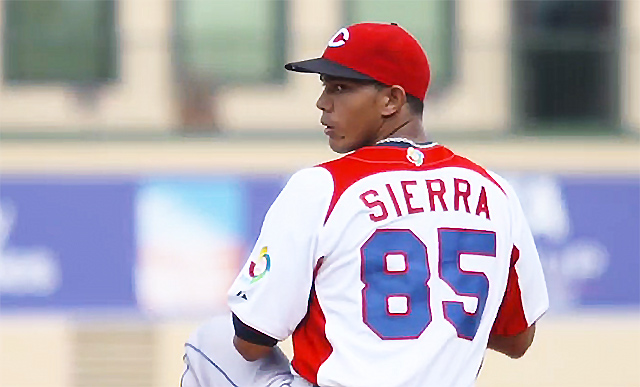
According to a team press release Sunday morning, the Los Angeles Dodgers officially signed Cuban righty Yaisel Sierra to a six-year contract.
Per Jeff Passan of Yahoo Sports, Sierra is expected to receive a guarantee of about $30 million. Because of his age and experience, he is not subject to the international signing guidelines.
Sierra, 24, pitched five seasons in Cuba’s Serie Nacional with Holguin (2010-14) and Sancti Spiritus (2012). During that span, he went 16-21 with 25 saves and a 4.23 ERA in 131 games which included 25 starts. In his 2013 season with Holguin, Sierra posted a 3.92 ERA with a 7.0 K/9 in 101 innings, despite recording a 5.7 BB/9.
In a report last week, Keith Law of ESPN (subscription required) noted that Sierra should be close to being MLB-ready and may best profile as a middle reliever when he debuts for the Dodgers:
“He has a very quick arm, coming from a high three-quarters slot with a 93-97 mph fastball and a hard cutter-like slider that flashes plus but is nowhere near consistent enough. He has no changeup to speak of yet and well below-average control.”
During a showcase in Florida last October, Sierra performed well before an audience of 350 scouts and baseball officials. Ben Badler of Baseball America (subscription required) recapped Sierra’s performance:
“Sierra threw 34 pitches on Thursday, including 19 fastballs, 12 sliders and two changeups. His average fastball velocity was 94.7 mph, and the pitch peaked at 96 multiple times and once dropped to 91. Sierra had outstanding command of his fastball down and to his glove side. He also had command of his slider in the same spot. Sierra’s slider broke with very late two-plane movement, and he ran it away from righthanded batters consistently, and the pitch showed the ability to compete in the strike zone. Sierra threw what appeared to be a changeup twice. The pitch had more vertical movement than his slider, and did not have overwhelming fade, though he did hit his spots with it.”
Badler also noted on Twitter that Sierra could rise to a potential mid-rotation starter with the help of a very experienced Dodgers’ pitching staff. In spite of the high risk factor, there’s reason to hope he can improve his control.
Also in the Baseball America interview, Sierra seemed excited and confident in regards to the development of his secondary pitches:
“I worked 24/7 for my slider and changeup,” Sierra told Teddy Cahill through translator and former big leaguer Alex Sanchez. “I was very excited to throw my slider and changeup because they don’t throw that kind of pitch in Cuba.”
To create room on the 40-man roster for Sierra, the Dodgers placed right-handed pitcher Frankie Montas on the 60-day disabled list after having rib resection surgery last week.
Manager Dave Roberts indicated early Sunday that Sierra should be arriving to camp within the next few days.
As the accolades continue to accumulate for the Los Angeles Dodgers on the prospect front, we thought it would be both interesting and insightful to have a look at the current top prospects at each position on the field.
Up until a few seasons ago, this list would have been very difficult to compile, as the Dodgers’ farm was extremely top-heavy with pitchers and outfielders. Today, as indicated by their favorable rankings by the top publications, the Dodgers not only have one of the best farm systems in baseball, but probably one of the most versatile as well.
These opinions are mostly subjective and original, and aren’t sanctioned or endorsed by any group or entity other than us here at this site. Here’s a quick peek at our top Dodgers prospects by position:
C – Austin Barnes
1B – Cody Bellinger
2B – Micah Johnson
SS – Corey Seager
3B – Brendon Davis
OF – Trayce Thompson
OF – Alex Verdugo
OF – Yusniel Diaz
LHP – Julio Urías
RHP – José De León
RP – Jacob Rhame
Austin Barnes is the obvious heir apparent to veteran catcher A.J. Ellis, and will most certainly see additional big league action at any sign of injury to either Ellis or Yasmani Grandal. With the catching position being one of the few spots in the organization without much depth, many say that Barnes could be one of the most valuable players on the farm. Evan Bladh of Opinion of Kingman’s Performancerecently put together a quality piece that further illustrates Barnes’ value.
At age 20, Cody Bellinger has already exhibited tremendous talent both with the bat and the glove, and will have an opportunity to shine as a non-roster invitee at this season’s spring training in Glendale. Bellinger still has a long way to go as far as physical development, but he showed a bit of a power surge last season for High-A Rancho Cucamonga, having mashed 33 doubles, 30 HR and 103 RBI. TBPC compiled an in-depth profile of Bellinger back in December.
Upon being acquired from the White Sox last December, it may have been safe to assume that Micah Johnson would have probably worked his way into the Dodgers’ lineup at some point during the 2016 season. Now, with Howie Kendrick, Chase Utley, Enrique Hernandez and Elian Herrera all on call to man second base, Johnson may have to wait until rosters expand in September to make his Dodgers’ debut. David Hood of True Blue LA compiled an informative piece regarding Johnson a few months back in his Dodgers’ prospect rankings series.
Since his Little League days, Corey Seager has exhibited immense success at every single level of baseball at which he’s competed. The consensus 2016 Rookie of the Year has recently been ranked the #1 prospect in baseball by the four major publications — Baseball America, Baseball Prospectus, MLB Pipeline and ESPN. While he will be playing under a microscope, Seager certainly has the tools to exceed all expectations.
For many years, third base has been the biggest void in terms of notable prospects in the organization. The latest (albeit several years ago), most-talked about minor league player to have his name thrown around at the hot corner was Pedro Baez, who most recently found success in the Dodgers’ bullpen. Today is no exception — there’s nobody that really stands out amidst the Dodger youth. We chose Brendon Davis here, as there’s been plenty of chatter about moving him to third from his natural shortstop spot, while his 6’4″ frame continues to develop. Kyle Farmer, a catcher by trade, has also recently spent time at third in an effort to build some type of minor league depth.
At 19 years of age, outfielder Alex Verdugo is one of the younger prospects to receive early recognition. Chosen in the second round of the 2014 draft, Verdugo has already advanced to High-A ball, as he continues to impress scouts with his bat speed and strength. He has the quickness and range to man center field; yet with a cannon for an arm, may eventually profile better in right. If he ever needs to fall back on pitching, he has a fastball that has reached 94 MPH, as well as a plus curveball and a quality changeup.
Like Johnson, Trayce Thompson was acquired from the White Sox in the three-team deal last December. There’s no question that Thompson has the tools and athleticism to succeed at all three of the outfield spots; however, after seven seasons in the minors, he’s yet to take that gigantic step forward. Still, he’ll be the first outfielder called upon from OKC when additional depth is needed in the bigs. Amanda Howell of Dodgers Way took a closer look at Thompson just a few days ago.
Yusniel Diaz, also 19 years of age, was signed by the Dodgers after he defected from Cuba last April. Diaz hit .348/.448/.440 in 2014-15 as an 18-year-old in Cuba’s top league, the Serie Nacional, and was the favorite to win Rookie of the Year honors before he left the country. Similar to Verdugo, he has the quickness to primarily handle center field, but his pure athleticism gives him the capability of succeeding at all three outfield spots.
Julio Urias, another 19-year-old, has long been considered the bread and butter of the Dodgers’ farm. He made his rookie league debut at the age of 16 with Great Lakes in 2013, and outside of having eye surgery and strict innings counts, hasn’t really had any setbacks. With a fastball that occasionally touches 98 MPH, a plus curveball and a very deceptive changeup, he has all the attributes that an organization desires in an ace. Ben Ellenberg of Outside Pitch discussed Urias a few weeks ago.
Up until last summer, José De León wasn’t even on the radar of any type of prospects list. However, after perfecting his changeup and climbing through both the High-A and Double-A levels, he’s now recognized as among the best right-handed starting prospects in the game. De León’s fastball, which has nasty, late movement and sits in the 93-96 MPH range, is by far his best weapon. His slider rates a little above-average but continues to improve. His changeup is by far his best off-speed pitch — he’s not afraid to use it when behind in the count and often uses it as his strikeout pitch. TBPC profiled De León in December.
The bullpen position was probably the toughest to choose among all the spots. Because Frankie Montas — who may even be utilized as a starter in the future — has experienced a setback with rib surgery, we chose Jacob Rhame based on his arm’s electricity alone. Jharel Cotton and Chris Anderson were also considered. Rhame’s strongest pitch is his four-seam fastball which sits at 95-98 MPH and peaks at 100 MPH. He equally mixes a cutter in the low 90s that offers plenty of movement. He also throws a really hard slider, which is recognized more for its velocity than break. He’s currently working on a change-up as a weapon used primarily against left-handed hitters. TBPC took a close look at Rhame back on February 5.
As non-roster invitees, Urias, Rhame, De León and Bellinger will begin camp with the big league squad at Camelback Ranch. In Cactus League play, Urias will wear number 78, Rhame 79, De León 87 and Bellinger 61. Barnes, Johnson and Thompson, already members of the 40-man roster, will wear numbers 28, 11 and 21, respectively. Seager will wear his normal number 5.
Pitchers and catchers report on February 19 and their workouts will begin February 20. Position players report on February 24 and the first full-squad workout will take place February 25.






 Think Blue Planning Committee