Dodgers Prospects: Will Micah Johnson Finally Break Through?

image-46

Being familiar with the Los Angeles Dodgers organization for over thirty years, it’s very difficult to remember a time when the team had as much depth as it does now. In the past, it seemed as if the club was abundantly stacked at one or two positions (starting pitching always being the most unmissable), but heading into the 2016 campaign, the Dodgers appear to be well rounded at almost every spot on the field.

Some positions are deeper than others, but one of the deepest spots on the diamond right now could very well be second base.

At the beginning of the winter, after Howie Kendrick elected to test the free agent market, it looked as if incumbent utility man Enrique Hernandez had a legitimate claim to man the keystone. However, concerned with Hernandez’s past success against right-handed pitching, the club re-signed Chase Utley, which created a presumable working platoon at second. At that point, it appeared the Dodgers were set at second base, with the future looking even brighter as Jose Peraza continued to climb the prospect rankings.

Then came the three-team deal with the Reds and White Sox in December which netted the Dodgers second baseman Micah Johnson, outfielder Trayce Thompson and pitcher Frankie Montas. Third baseman Todd Frazier landed in Chicago, while the Dodgers sent Peraza, outfielder Scott Schebler and infielder Brandon Dixon to Cincinnati. All three prospects the Dodgers scored were very much considered to be MLB-ready.

All at once, the Dodgers became even deeper in terms of reserve players and minor league depth.

Subsequently, when the bottom fell out of the second base free agent market, the Dodgers were able to bring back Kendrick on a very economical two-year deal. There was talk about both Kendrick and Utley possibly getting time at third base, but the consensus around camp right now is that they’ll share time at second, while Hernandez likely slips back into his super-utility role.

mjdodgers

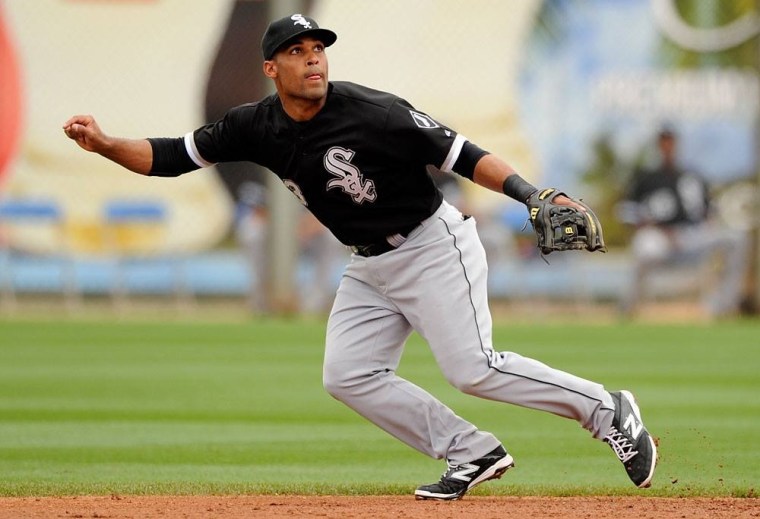
So where does that leave Micah Johnson?

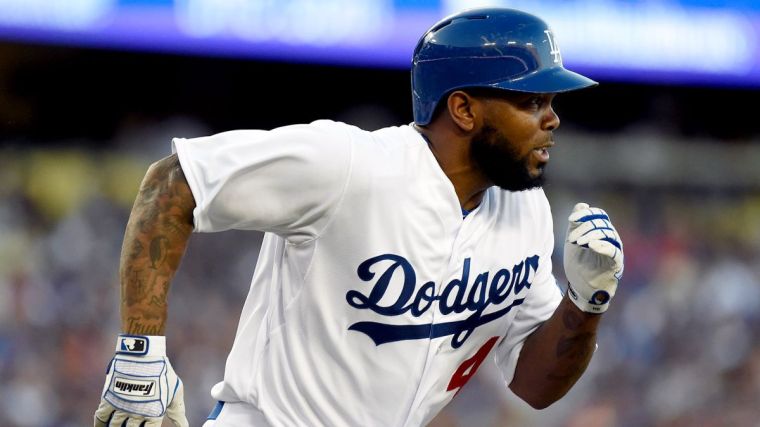
When healthy, the presences of Kendrick and Utley keep him in Oklahoma City, but at the first sign of injury, Johnson will be among the first players to get the call to help man second base. Outside of providing secondary depth, the Dodgers’ immediate interest in Johnson could be for his speed on the basepaths, and for his usefulness in late game situations as a pinch runner once rosters expand, or maybe even in the playoffs.

Johnson’s best assets by far are his overall speed and his quick first step. His run tool is rated a 75 on the 20-to-80 scouting scale. Johnson was successful on 28 steals in 35 attempts at Triple-A in 2015, and stole as many as 84 bases in 2013 between Single-A Kannapolis and Double-A Birmingham. In 143 career games at the Triple-A level, he swiped 40 bases in 53 attempts (75.5 percent).

In terms of offense, Johnson has always found success at Triple-A, but hasn’t found much consistency in his limited time in the majors. He hit .315/.375/.466 in 78 games in Triple-A Charlotte last year, then hit .230/.306/.270 in his first 36 games in the bigs.

In the majors and minors combined in 2015, Johnson hit .300/.366/.455 against right-handed pitching and .287/.347/.346 against lefties.

The biggest knock on Johnson so far during his young career has been his defense, but according to his own accounts, what was once considered a small throwing hitch by scouts snowballed into a stereotype that he is error-prone with his glove.

“I know there were some things [the White Sox] wanted me to clean up, like turning a double play, but that was all because I had a hitch in my throw. That had nothing to do with my footwork, my hands. Routine plays have never been an issue. I field those fine. I get the outs,” Johnson said.

“I think some people get that confused, like, ‘Defensively, he makes errors’ or something like that. That’s not the case at all. I just had a little hitch in my throw and some double plays didn’t get completed. This offseason, I cleaned that hitch up. I had a couple months to just work on my throwing, short compact throws, using my torque and my body.”

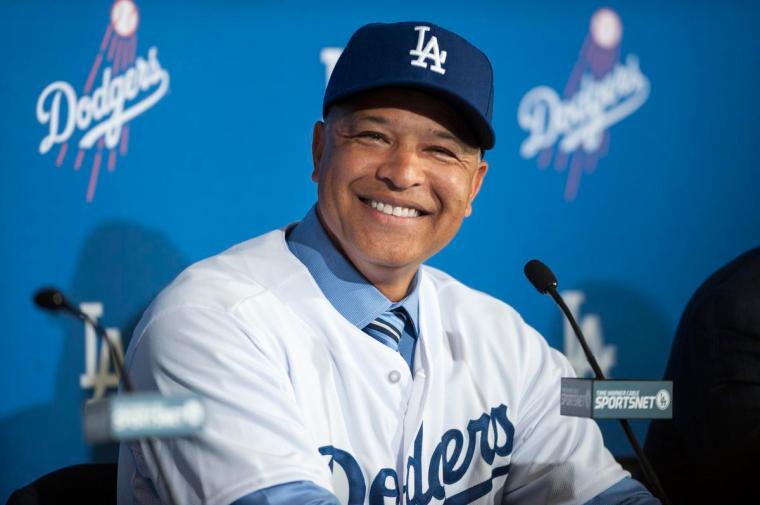
Dodgers’ manager Dave Roberts has a keen interest in Johnson, and thinks his best chance to stick might be as a second base/outfield utility role player.

“Micah is a dynamic player, he’s an interesting player,” Roberts said. “He is continuing to work on the defense and he’s taking balls in center field. He can run. He has that dynamic speed that we really don’t have, so a lot of times young players start to get ahead of themselves. We’ve talked about how it’s just a matter of him performing.”

When asked about what qualities he brings to a team that’s already two to three players deep at most positions, Johnson was quick to point out his aggressiveness with his bat and on the bases.

“I play the game the right way. I play hard, play to win. The numbers take care of themselves. If a runner’s on second base, nobody out and I bunt — can I get a hit out of it? Runner on third with less than two outs, my job is to bring him in somehow, some way. Even first and third with less than two outs, if I put the ball in play, it’s going to be hard for them to get a double play. When I put the ball in play, I know my game and I focus on winning the game and the numbers take care of themselves.”

Johnson realizes that both Kendrick and Utley have him blocked for the early part of the season, but he’s staying focused on winning and remains confident about his chances on contributing to the big league squad in some capacity.

“Everybody [in big league camp] has the sense that everybody’s going to contribute at some point toward the ultimate goal to win the World Series,” Johnson said. “If we win the World Series and you helped the team win three or four games, then you helped them win. There’s not much disunity between what level you’re supposed to be at and who you are. No one cares about that. … There’s not very much I want to accomplish except winning: ‘What did I do to help us win?'”

(Photo Credits: whitesoxpride.mlblogs.com & Joe Camporeale/USA TODAY Sports)

There’s (Some) New Kids in Town

cody-bellinger-hitting-2014-raptors-noall-knighton.0.0

“There’s talk on the street; it sounds so familiar
Great expectations, everybody’s watching you
People you meet, they all seem to know you
Even your old friends treat you like you’re something new.” ~Glenn Frey/Don Henley

Anyone paying a half bit of attention has noticed that there are quite a few names making noise in the Dodgers‘ spring training camp this year. Some are becoming famous on Twitter, such as Cody Bellinger for his quest to get to 10,000 followers (#CodyLove), Jack Murphy for his amazing hair, and Charlie Culberson for his sky high batting average. Others are opening eyes with their speed (Rico Noel), or clutch hitting like Rob Segedin. I thought I’d take a quick look at some of this newfound depth the Dodgers have.

Cody Bellinger – Cody is a left-handed first baseman who was drafted by the Dodgers in the fourth round of 2013 draft. Bellinger is the #6 ranked Dodgers prospect on MLB Pipeline. He has spent the last two years with Ogden and Rancho Cucamonga, where he was selected to both the mid-season and postseason All-Star teams.

He has a wonderful progression, hitting three homers in 2014, and 30 in 2015, which he attributes to fine-tuning his swing mechanics and putting some weight on his 6’4″ frame. He seems to be the heir apparent to Adrian Gonzalez at first base. Bellinger was given his first non-roster invite to spring training this year where in five games, has a .667 average with a 1.394 OPS. (Dennis composed a profile on Bellinger back in December)

Charlie Culberson – Culberson is a right-handed hitting utility infielder who was drafted by the San Francisco Giants in the first round of the 2007 draft. He was traded to the Colorado Rockies straight-up for Marco Scutaro in 2012. He was eventually called up to the majors on July 29, 2013, platooning with Corey Dickerson in left field. Culberson signed a minor league contract, which included a spring training invite, with the Dodgers last November. He started off incredibly hot, and through six Cactus League games he has a .700 batting average and 2.000 OPS.

Jack Murphy– Murphy is a doppelgänger of Oakland A’s pitcher Dennis Eckersley — long wavy hair and a fantastic mustache. Murphy came from Toronto in the trade that saw Darwin Barney depart Los Angeles. The switch hitting catcher attended Princeton University and has played the last three offseasons with the Canberra Calvary in the Australian Baseball League, where he was named both their MVP and Silver Slugger in the 2014 season. In three games this spring he is batting .500.

ABL_CAN_SYD_G4_0030_xa4yznop_dcmvzfqi

Rico Noel – Jablonski Rico Noel was drafted in the 2010 MLB draft by the San Diego Padres. He stole 90 bases in 2012 with the Lake Elsinore Storm in the Class A-Advanced California League. He was in Triple-A in 2015 with the Padres, but ultimately asked to be released. After signing a new deal with the Yankees, he was promoted to the majors on Sept 1, 2015. He hit a single in his first plate appearance and stole five total bases for New York last season.

Noel was removed from the Yankees’ 40-man roster over the winter, eventually signing with the Dodgers to a minor league contract with an NRI to spring training. In eight games this spring, he’s only batting .222, but has stolen three bases. He could make a great late season call up, especially considering manager Dave Roberts‘ philosophy of manufacturing runs.

Rob Segedin – Segedin is a right-handed hitting corner infielder/outfielder who’s career has been plagued by injuries. He has suffered from Pars Defect, a stress fracture in the vertibrea of the spine, in addition to femur defects that saw him undergo labrum surgery and having the bones of his hips shaved. He was heathy through 2014, but sprained his wrist in 2015 going into the stands after a ball.

Segedin came to the Dodgers over the winter via trade with the Yankees for Ronald Torreyes and Tyler Olson. He’s off to a hot start in spring training, having a two-homer game and batting .313 with a 1.228 OPS. Playing first, third and the outfield, he figures to start at third for Oklahoma City, and be there waiting in the wings if injuries begin to plague the infield.

Trayce Thompson – Selected by the Chicago White Sox in the second round of the 2009 draft, Trayce played most of his career in the minors, being promoted to the Majors on August 3 2015. On December 16, 2015, he was traded to the Dodgers along with Frankie Montas and Micah Johnson in a three team trade that included the Cincinnati Reds sending Todd Frazier to Chicago and three players from LA to the Reds.

Trayce, as has been widely reported, is the brother of 1/2 of the Splash Brothers, Klay Thompson and son of former NBA player Mychal Thompson. He is the Dodgers #15 ranked prospect by MLB Pipeline and has played in seven of eight spring training games. An outfielder, he is poised to be in contention for Carl Crawford‘s spot of the roster should Crawford continue his decline in play.

While all stats in spring training should be taken with a grain of salt, it is safe to say that the Dodgers have players that have added excellent depth for this year and for years to come.

(Photo Credits: Noall Knighton/Ogden Raptors & Ben Southall/SMP Images)

Dodgers’ Roberts Creating New Type of Synergy in Camp

nypny4-b88581169z.120151201191819000g1qdgig2.10


When Dave Roberts exited the room after his initial managerial interview in Los Angeles last November, members of the Dodgers‘ front office knew immediately they had their man.

“Everyone was blown away by who he is, what he represents. You can see his energy, you can see the enthusiasm, and his ability to connect with people,” Andrew Friedman said.

“There’s a positivity and energy to Dave that really is the overriding thing in any conversation you have with him,” Farhan Zaidi added. “You can feel it in any room that he’s in.”

Today, fully entrenched in the daily operations of spring training, Roberts is creating a new type of energy among the players — employing creative team building exercises with total player involvement and even going as far as utilizing cutting edge neurological technology.

Bill Plunkett of The OC Register was among the first to report the Dodgers’ application of “NeuroScouting,” which, according to outfielder Scott Van Slyke, “is the science of improving your performance in terms of reaction and recognition.”

“I think it’s certainly about being open-minded (as an organization). In this day and age, there’s a lot of research and time spent on various technologies. We vet it very thoroughly on the front end and introduce different things to our players with what we’ve learned and make it something that’s available to our guys if they want to try it,” Friedman said.

As far as the teamwork-type of activities, Plunkett cited several examples which involved numerous players having to to plot the hometown of all their coaches and teammates on a map, as well as one player, Cody Bellinger, needing to chronicle his attempts to reach 10,000 Twitter followers by the end of spring training.

Bellinger even went as far as preparing a fundraising chart which documented his progress. Many of Bellinger’s teammates and coaches reached out to their own audiences on Twitter to help the cause:

In addition, Roberts also held “Coffee with Doc” sessions where players had isolated meetings with Roberts and other members of the training staff, coaching staff and front office, giving all the new members of the organization an opportunity to become familiar with one another.

“I got a lot of it from Buddy Black (ex-Padres manager) and I think he learned it from (Angels manager Mike) Scioscia. There are certain things you take from everybody that you like and some that you don’t and that don’t make sense, but that is one of those things I really enjoyed,” Roberts said.

In light of all of Roberts’ efforts, the squad seems to be heading in a new direction in terms of chemistry — something that former manager Don Mattingly, with his laid-back and unruffled approach, was often criticized for not working harder to attain.

Regardless, while all the synergistic games and team building exercises may be great for boosting morale in camp, they don’t necessarily translate to wins on the baseball field.

Ultimately, the manager can only do so much, as it’s up to the players to perform and orchestrate the victories on the diamond.

However, if the squad embraces even a small portion of the energy, knowledge and experience that Roberts is exuding, 2016 could turn out to be a very special season.

(Photo Credit: Ed Crisostomo/OC Register)

OneOK Field: My Home Away from Home

DTTULSA6

When Dodgers fans think of their home away from home, Dodger Stadium, there are quite a few words that come to mind — Historic, Dodger Dogs, Tommy Lasorda, Iconic and Magical are just several examples.

Following the Boys in Blue, I have visited 11 other major league stadiums with not a single ballpark coming close to the atmosphere of Dodger Stadium on a beautiful summers night. Sure, I may be a little bias, but who isn’t for their favorite team.

20150411_191844

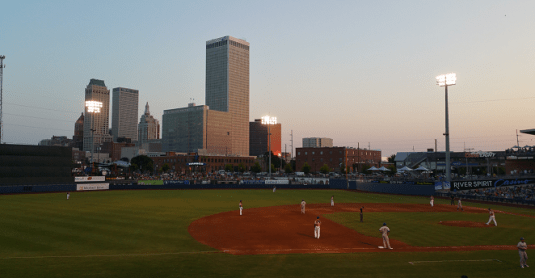
OneOK Field is one of the most state-of-the-art stadiums to which I’ve ever been. From the amazing video board to the first to third ribbon board, this stadium is a crowd pleaser.

One cannot forget to mention the beautiful view of downtown Tulsa, racing appliances, Hornsby and Justin(@JustGo11) who keeps the crowd going in between innings. As a Dodgers fan, I feel like the vibe at OneOk Field is pretty close to being at Dodger Stadium as the fans are just as passionate about their team and players.

The opening weekend of 2015 in Tulsa was an amazing experience that I wish every Dodgers fan could have experienced. Most of the fans at the game were fans of their home team, the Tulsa Drillers, but I did see quite a few Dodgers hats in the crowd. It was great to be able to educate the fans around me about the new players on their team and their hopeful future with the Dodgers. They won two of three games over that first series and we spent parts of each game walking around the stadium.

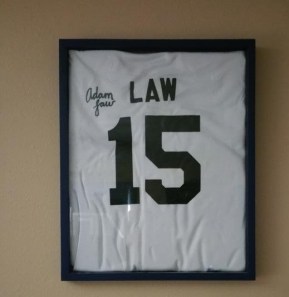
OneOk Field, much like Dodger Stadium, is filled with the history of players who have worn the jersey. A walk through the concourse will have you come across banners of Pudge Rodriguez and Sammy Sosa. We then took a trip to the team store which is run masterfully by T.J.(@drillermatchguy) and saw jerseys of Troy Tulowitzki and Nolan Arenado hanging on the wall. The team store is full of friendly staff and great team gear. I was a little difficult as I wanted a custom jersey with #15 and “Law” on the back and T.J. made sure it was finished by the end of the game. This Adam Law jersey still hangs on my wall to this day.

CJMDuTzUYAAn6-w

Season One of the Tulsa Drillers as a Dodger affiliate was life changing for me. Being there for 21 games I got to watch the people of Tulsa fall in love with the players that were all new to them. The players had a big role in this as they were beyond fan friendly. Always willing to sign an autograph, take pictures and interact with the fans. I probably saw Corey Seager sign 100 plus autographs the first weekend.

As the season went on it went from the fans cheering for the Drillers to them cheering for the players as well. By the end of the season we had become very well known in DrillVille as we frequented the scoreboard as a fan tweet, chatted with the players and sat through 18 inning games. It was great seeing the Dodger fanbase growing throughout the Midwest.

In the coming weeks, I am hoping to do some Q&A’s with some of the players that made last season memorable for me. If you have any questions that you have always wanted to know from a baseball player, please comment or tweet at me and I will get the questions answered as best I can. I really want this part of the blog to be for the fans by a fan. I also plan on doing some giveaways this season of autographed baseballs.

Dodgers, Roberts Plan on Rotating Leadoff Batters in 2016

092815-MLB-National-League-MM-PI3.vresize.1200.675.high.83

Whether it’s a mandate that trickled down from the front office, a decision that Manager Dave Roberts arrived upon himself, or a collaboration between the two, it was revealed on Tuesday that the Dodgers tentatively plan on rotating numerous players at the leadoff spot in the batting order when regular season play begins in April.

Doug Padilla of ESPN recently pointed out that everyone from Howie Kendrick to Carl Crawford to Joc Pederson to Corey Seager to Enrique Hernandez could have the leadoff job at some point, and that Roberts appears to be fully on board with the sabermetric philosophies of the front office.

“You know what, I think that as a former leadoff hitter, we have all been conditioned for routines and consistency, but I think that as this game has evolved, we’ve all had to see things in a different way,” Roberts said. “I’ve had many conversations with the players that there will be some change. I think that where you hit in the order in years past, in decades past, there is a lot to be said for that. But this day and age, with the data that we have, sometimes change is good.”

Padilla also indicated that Roberts will use advanced analytics to determine who hits where throughout the entire lineup — not just with the leadoff spot.

Kendrick seems to be the favorite to command most of the repetitions hitting first in the batting order. As early as the Dodgers’ first Cactus League matchup against the White Sox last week, Roberts believed Kendrick would be in the mix for the leadoff role. Per Eric Stephen of True Blue LA:

Back in January, TBPC discussed the logistics of the modern leadoff batter, and concluded that players who get on base more frequently and hit the ball harder are actually more beneficial to a team’s success than the traditional speed burner, adding that both Pederson and Yasiel Puig had the tools to productively slot into the Dodgers’ leadoff role.

Ken Gurnick of MLB.com specified that in 2014, the last year of the Ned Colletti regime, the Dodgers used six different leadoff hitters. Dee Gordon hit first in the lineup the most, leading off in 133 games total, while the team used 142 different lineups during the entirety of the season.

Last season, the first under president of baseball operations Andrew Friedman, the Dodgers used 12 different leadoff hitters. The club used 137 different lineups altogether, tied for seventh-most in the bigs. Pederson led off the most times, starting 69 games batting first.

Many fans will argue that continuity and team chemistry could possibly be affected by the revolving batting orders and potential positional platoons, but Roberts seems to have a firm grasp on the strategies for the upcoming campaign.

“There is an argument to be made for (continuity), but regardless of where an individual hits in the lineup, it shouldn’t change how they are as a hitter,” Roberts said. “Adrian (Gonzalez), if he hits third or fourth, he is going to be Adrian. Whether Howie hits first or second, or he hits fifth, he should be the same hitter. I think Chase (Utley) will be the same way. If you look at the guys on our roster, that’s the way that should be.”

Roberts will have until the end of the month to experiment and analyze which lineup combinations will be best for the club to begin the season. New base coaches George Lombard and Chris Woodward also bring fresh perspectives in terms of enhancing baserunning skills and improving run production.

The Dodgers open the season against the Padres on April 4 in San Diego.

(Photo Credit: Lisa Blumenfeld/Getty Images)

De León Impressive for Dodgers in Cactus League Debut

Jose-De-Leon

While much of the attention fell upon Japanese righty Kenta Maeda in the Dodgers’ 7-2 victory over Arizona in Saturday’s Cactus League contest, the first spring appearance of highly rated pitching prospect Jose De Leon was equally as exciting.

De León entered the game in the sixth for the Dodgers, and quickly allowed a leadoff double to Diamondbacks’ shortstop Nick Ahmed. After an errant pickoff throw to second base (which could have resulted from a case of testy nerves), De León came back with a vengeance and struck out the side to end the inning.

Continuing into the seventh, De León did allow a single, but tallied another strikeout, then ended his outing with a very tidy groundball double play.

Here’s a quick peek of all three of his strikeouts in the sixth inning:

De León was credited with the highly coveted spring training win.

Manager Dave Roberts sounded impressed with De León’s debut performance.

“Jose throwing strikes, keeping the ball down,” Roberts said. “Mixes his offspeed pitches in there. Had a baserunner on, held the runner well. Mixed in a quick step once in a while. Just his composure he had out there was good to see.”

Although a longshot candidate, De León is still in the running for a spot in the Dodgers’ starting pitching rotation after teammate Brett Anderson had surgery earlier in the week for a bulging disc in his lower back.

Maeda also threw two scoreless innings on Saturday while striking out two and giving up only one hit. He threw 28 pitches and faced the minimum six batters, despite giving up a double to Phil Gosselin, who was eventually thrown out trying to steal. With the Dodgers employing a defensive shift to the right side against David Peralta, shortstop Corey Seager was able to cover third base and tag out Gosselin.

“He was very efficient,” Roberts said of Maeda. “There were some swings and misses, he made some good pitches. We were thinking about getting out there again since his pitch count was so low. He made a joke with [pitching coach Rick Honeycutt] and said he was tired. It was good. We were pretty excited.”

Newly acquired utility man Rob Segedin led the Dodgers with two homers, one in the sixth inning and the other in the eighth.

Zach Lee, who is also believed to be a candidate for the Dodgers’ starting rotation, faces the San Francisco Giants and RHP Jeff Samardzija Sunday at 12 p.m. PT in Scottsdale.

The game will be available on both television (SportsNet LA) and radio (KLAC 570 AM).

(Photo Credit: milb.com)

Rethinking the Dodgers’ Starting Rotation

092815-MLB-Los-Angeles-Dodgers-Brett-Anderson-PI-JE.vresize.1200.675.high.26

It was only about a week ago that almost every writer in the Los Angeles Dodgers‘ blogosphere expressed an opinion about Alex Wood and what type of role he would play in the upcoming season.

Now, with Brett Anderson having had back surgery and expected to miss three to five months, Wood has been quickly ushered to the fourth spot in the starting rotation, while the Dodgers are left scrambling to swiftly determine which pitcher slots into the fifth spot.

The popular opinion, at least among many of the Dodgers’ beat writers in attendance at Camelback Ranch, is that the best option is to lean towards one of the three players who have MLB experience — Mike Bolsinger, Carlos Frias or Brandon Beachy.

Depending on the overall spring training evaluations, Bolsinger could very easily be the safest choice of the trio, despite having several glaring inconsistencies.

In 2015, Bolsinger ended up contributing 109 innings over 21 starts for the Dodgers, compiling a 6-6 record with a 3.63 ERA, a 8.1 K/9, and a 3.91 FIP. For those unfamiliar with FIP (fielding independent pitching), it separates a pitcher’s performance from the ballpark and defense around him. Generally if a pitcher’s FIP is higher than his ERA, it usually means the ERA is on the upswing.

Indications also suggest that Bolsinger’s lack of velocity has a bearing on his performance when facing opposing hitters the second and third times through the batting order. Not that a pitcher with a lower velocity can’t have success, but somebody with an average fastball of 89.2 mph and a slider floating in at 80.6 mph who can’t precisely hit his spots makes it much easier for the opposition to succeed.

Frias, on the other hand, has an electric arm and a very high ceiling based on his velocity alone. He made 17 appearances, including 13 starts, for the Dodgers last season, hurling 77.2 innings to a tune of a 4.06 ERA.

The knock on Frias is that the separation of speeds between his hard stuff and his breaking pitches is so small, that it allows opposing batters to make better reads. Last year, for example, both his fastball and sinker averaged in the 97-98 mph range, while his changeup averaged 91.8 mph. Until Frias can develop and command a more effective arsenal of breaking pitches, he may be better suited for the bullpen.

There’s really not much recent data to make a fair assessment of Beachy. After returning from Tommy John surgery last season, he pitched 47 innings over 10 appearances at Oklahoma City. When given the opportunity with the Dodgers, he surrendered 10 hits and seven earned runs in the two games he started.

One concern with Beachy is that he altered the mechanics of his delivery to avoid additional problems with his elbow. In his old delivery, he threw across his body to generate better spin, whereas now he throws more in a straight line towards the dish with less rotation. Whether this proves to be beneficial and effective in the long run remains to be seen.

While the safe bet may be to ride the shoulders of one of the aforementioned pitchers, the brain trust here at TBPC believes that one of the second-tier options — José De León, Zach Lee or Jharel Cotton may be the better alternative.

De León’s fastball, which has nasty, late movement and sits in the 93-96 MPH range, is by far his best weapon. His slider rates a little above-average but continues to improve. His changeup is by far his best off-speed pitch — he’s not afraid to use it when behind in the count and often uses it as his strikeout pitch. He’s considered to be MLB-ready and possesses the most raw talent of the three.

In terms of mental makeup, Lee is probably the most mature prospect in the organization. His command is very sharp, which was made evident by his 1.5 BB/9 last season. His sinker is consistently solid, resulting in a 50% ground ball rate. His slider is still developing, which will eventually compliment his four-seamer, changeup and sinker. Lee still shows plenty of velocity with the heater, having the ability to reach up to 94 mph.

Cotton probably has the best changeup in the Dodgers’ entire system, and projects much better as a starter after a short stint as a reliever in Triple-A last season. His fastball is still somewhat of an enigma, sitting in the mid-90s at times then sitting 90-91 other times . His breaking pitches are his best weapons, leading him to a 10.7 K/9 in almost 100 innings of work last year.

Of course, any rookie could have the finest skills on the diamond, but ultimately head downhill when given a shot in the bigs. Psychological fortitude is critical at the major league level — having the ability to see past a rough outing, having the mental endurance to stay strong the entire season and having the capacity to be coachable are just several attributes that are paramount for success.

While their performances on the field at spring training will have the most influence on who gets the eventual call to be the fifth starter, option years and 40-man roster implications aside, it very well could be time for one of the kids to step into the rotation and shine above the rest.

(Photo Credit: Dustin Bradford/Getty Images)

Dodger Blue in A Sea of Red

(Editor’s note: TBPC would like to welcome aboard another new member to the writing team, Jeremy Davis. Jeremy will primarily be conveying his own hands-on, personal perspectives in relation to the Tulsa Drillers, as well as occasional reflections involving the other minor league affiliates. Be sure to check back often, as Jeremy hopes to frequently publish many more insightful articles.)

In 2001, I made a tough decision in life… I moved away from my family and 1,539 miles away from my piece of heaven. Dodger Stadium was a place I spent many a summer night with my friends out in the bleacher seats, eating Dodger Dogs and cheering on the Boys in Blue. My new location was deep in the heart of Cardinal territory and boy was it strange. I was a blue dot in a sea of red.

travel.png

I remember the day I found out that my Dodgers had changed their AA and AAA affiliate to be within a few hours of me. I checked to see if we could swing season tickets, could we move there ASAP and how many times they would be in Springfield, Mo. The answers were no, not right now and 18 games. 1 out of 3 wasn’t bad, right? We decided to become partial season ticket holders to the Springfield Cardinals with seats behind the visitor’s dugout for every game the Tulsa Drillers were in town.

Opening weekend we took a road trip to Tulsa for opening night at OneOK Field. Opening night was full of everything picture with Corey Seager, tweet on the scoreboard and a nice Drillers win. The next night it was on to OKC for the next game. Kiké, Bolsinger and Dodger dogs. My wife is no rookie when it come to my Dodger fandom but this made it all more apparent my love for the team. Two wins, great food and amazing memories.

20150411_194946

That first season in Tulsa was full of highs for me with very few lows. Every game I left the park with a smile on my face win or lose because of the experience. Whether a game ball signed by Julio Urias, being photobombed by Nate Samson or tickets left by a player there was always something new at every game. As the season went on I became a familiar face for the Tulsa Drillers players and coaches when they were in town. That first season we collected signed balls,  bats, hundreds of pictures and player interactions that will last us a lifetime. Oh and we met Tommy freaking Lasorda. With season 2 on the horizon, I decided it was time to share my adventures with all and hopefully pass along some souvenirs.

20150521_230858.jpg


What About Bob?

bob-geren-terry-collins-mlb-nlds-new-york-mets-los-angeles-dodgers-850x560

There’s another new coach I don’t know much about in the Dodgers‘ dugout. Bob Geren will be joining rookie manager Dave Roberts as bench coach. Geren is filling the role left by Tim Wallach, who followed Don Mattingly to Miami.

Geren is a former catcher who spent 10 years in the minor leagues before making his debut with the New York Yankees in 1988. He stayed with the Yankees for four years, spent a year in the minors with the Pawtucket Red Sox, then played his final year with the San Diego Padres in 1993.

Geren has coached his way through the ranks, starting in the Red Sox organization at both the Rookie and Class A levels, before joining the Oakland A’s to manage their Triple-A team in Sacramento. He was promoted to bench coach for the A’s in 2002, where he remained through 2006. On November 27, 2006 he ascended to manager in Oakland, where he guided the A’s to their first losing season since 1998.

His time with Oakland was rocky — he received an extension on his contract, but his managing style was questioned after several players voiced their displeasure. Former A’s reliever Huston Street called him the “least favorite person I have ever encountered in sports.” He was fired on June 9, 2011.

920x920

On October 14, 2011 he was hired to be the bench coach for the New York Mets. Geren would go on to spend four years in New York, which included a run to the World Series last season. In December, he was hired by the Dodgers to be bench coach, after having interviewed for the managerial position in early November. Geren and his wife are from California, and have stated that the favorable location had weighed a lot in his decision to come to Los Angeles.

Geren has many good things to say about manager Dave Roberts. In an interview with Robert Pace of Fox Sports, Geren said, “His (Roberts) enthusiasm is infectious, his personality is off the charts. He’s a great pick, just a great choice.”

Geren also feels that he can be a good teacher for the younger Roberts, and that they can lean on and learn from each other.

Hearing that he’s been called the “least favorite person” that someone has met in sports in concerning for sure, but his years of experience and his willingness to be open to the ideas of the front office should provide a good sounding board for Dave Roberts as they strive to take the Dodgers deep into the postseason.

(Photo Credits: Jayne Kamin-Oncea, USA TODAY Sports & Ezra Shaw, Getty Images)

Dodgers Starting Rotation: The Future of Alex Wood

Alex Wood
Los Angeles Dodgers starting pitcher Alex Wood throws during the first inning of a baseball game against the Cincinnati Reds, Tuesday, Aug. 25, 2015, in Cincinnati. (AP Photo/John Minchillo)

Nowadays, typical fans of the Los Angeles Dodgers never seem to be satisfied. Understandably, it is tough to blame them, being that it’s been 27 years and counting since the team’s last World Series championship.

And the same typical fans can sometimes be a bit delusional — as we all very well know. Usually, it’s the constant criticism of the front office not spending more money, trading away a player who was a fan favorite, or not making that blockbuster deal just moments before the trade deadline. The psychological progressions and maddening obsessions eventually lead to the fans’ own personal greed and uninformed opinions coming to light, instead of realizing what’s best for the team in the long run.

The same can be said for Dodgers’ pitcher Alex Wood, at least up until several weeks ago. The moments after the team signed free agent pitchers Scott Kazmir and Kenta Maeda, the unenlightened fans began to work their glamour, calling for an immediate trade, only because the starting rotation was now overloaded with players who were more talented than Wood, and the bullpen already had two left-handed pitchers and two long men.

The fans had somewhat of a right to be critical, though, as Wood’s time in a Dodgers uniform after being acquired from the Braves resulted in a bit of a roller coaster ride.

His decreased velocity led to a plummeting strikeout rate. In 2014, he flaunted a respectable 8.91 K/9, while his overall numbers last year produced a mere 6.60 K/9. His 116 ERA- and 106 FIP- for the Dodgers were well below his career averages. And the home and away splits were also extremely noticeable.

Wood made five starts at Dodger Stadium, and all five were quality starts, reeling out a 2.41 ERA, a 3.25 FIP, a 20.2 percent strikeout rate and a 4.1 percent walk rate.

On the road, however, Wood made seven starts after joining the Dodgers, and just one was a quality start, resulting in a 6.14 ERA, a 4.88 FIP, a 14.3 percent strikeout rate and a 10.7 percent walk rate.

And to boot, a pitcher with a fastball topping out at 89 mph, an extremely low arm slot and a very strange delivery is never overly appealing to the typical fan.

All that being said, it came to light about a week ago that Wood has spent his whole Dodger career playing with a bone bruise in his right foot.

LA Times beat writer for the Dodgers, Andy McCullough, was first to report the details of the injury on February 22. In his final game with the Braves, Wood rolled his right ankle on a play covering first base. A bone bruise developed in his foot, which pained him every time his foot landed when he threw.

Wood used almost the entire winter letting his foot heal, and once he was able to throw pain-free, began to polish and fine-tune his mechanics.

“I had already gotten into some bad habits mechanically,” Wood said. “So it was a long offseason full of trying to get back to where I needed to be.”

The news of Wood’s injury, coupled with the actuality of Hyun-jin Ryu‘s delayed return, left fans more forgiving and forced them to realize that Wood is much more valuable to the team than what they perceived originally.

As for the beginning of the season, Wood will more than likely slot into the fifth spot in the rotation, at least until Ryu is ready to return, which could extend into May.

It’s been a number of years since the Dodgers’ main starting rotation stayed healthy for the bulk of a season, and Wood will remain on alert to fill any need when an injury does occur.

Early estimates for the usage of Ryu were calculated at the 20-start and 150-inning range. No projections were given for Maeda; however, both Maeda and Ryu are accustomed to throwing once per week rather than every five days, which may leave another door open for Wood.

It could be easy enough to sculpt a potential six-man rotation, where Wood would pitch on Maeda and Ryu’s scheduled fifth day, stretching time between starts and giving Maeda and Ryu the required rest that was common in their homelands — a large enough role to warrant Wood a spot on the 25-man roster.

As for the future, so long as his numbers stay stable and consistent, Wood is more valuable to the club than many fans realize. Brett Anderson is signed only through the 2016 campaign, while Kazmir’s contract involves a potential opt-out after this season. Brandon McCarthy, who is expected to return at some point during 2016, is only signed through 2017.

In terms of team control, Wood will not be eligible for free agency until the year 2020, and has all three option years remaining on his contract — a scenario that is valued very highly by today’s front offices.

Nevertheless, utilizing an option and being sent to the minors for any length of time isn’t an alternative in Wood’s eyes.

“I’m going to be in the rotation,” he said. “That’s the plan. That’s the thing I hate about the offseason, about spring training. I’m more about action than about talk. I plan on being in the rotation. And I don’t plan on leaving.”