Dodgers Starting Rotation: Kenta Maeda Making Early Impact

hi-res-30700b12118e96be5b2d0a7db944d658_crop_north

(Photo Credit: Ross D. Franklin/Associated Press)

Without a doubt, the hottest topic among Dodgers fans everywhere this spring has been the state of the starting pitching rotation. While several injuries are already preventing numerous starters from being in uniform on Opening Day, the signing of Japanese righty Kenta Maeda this offseason is beginning to appear brilliant.

The rumor around baseball is that the irregularities in his physical examination drove down the price tag of his contract, as made apparent by the Dodgers and Maeda’s representation never officially releasing a statement. Regardless, if he stays healthy and resembles a little of what he’s shown so far this spring, the eight-year deal worth a guaranteed $25 million may begin to pay dividends early.

Upon joining the Dodgers in December, early expectations from team management and scouting pundits were that Maeda had the ceiling of a back end rotation guy — an innings eater type with the potential to fill the four or five slot. Now, with Brett Anderson out three to five months after back surgery, and Hyun-jin Ryu not expected back until at least May, any offerings resembling a No. 2 or even a No. 3 starter would truly be welcomed.

So far in camp, Maeda seems to be adjusting to pitching in his new country nicely. Making his third Cactus League start Tuesday against the White Sox, he tossed 3-2/3 innings, allowing two runs (neither earned) while striking out three and walking two.

Overall this spring, Maeda has thrown 8-2/3 innings over three starts, allowing seven hits, four walks and no earned runs, having struck out eight batters.

His walk and hits total may seem a bit high, but Maeda says he’s still getting a feel for the strike zone.

“There were times when I threw pitches on the corner that I wanted strikes on but were called balls,” Maeda told Kyodo of The Japan Times.

“Had I got them, I would have had more strikeouts. I think I’m going to have to establish my reputation among the umpires as a pitcher with good control,” he added.

“I’m still throwing some fat pitches, but I was able to get some strikeouts, so it was a learning experience. Next time I want to do a good job while increasing my innings and pitch count and not walking batters.”

For those unable to watch Maeda throw on television or video, his pitching motion is almost identical to Hisashi Iwakuma of the Mariners. It’s almost reminiscent of the delivery of Dodger legend Hideo Nomo, minus the hip twist. Here’s an example of Maeda tossing a breaking pitch:

As for his repertoire of pitches, he’s no Zack Greinke, but he’s shown four different types of pitches this spring. His fastball has been clocked in the 90-91 MPH range, while his slowest curveball came in at 70 MPH. His changeup and slider are almost indistinguishable on the gun at 80-81 MPH, which will play especially well against right-handed batters.

Maeda is also rumored to be working on a “front door” slider, which he learned from fellow countryman Hiroki Kuroda — a pitch designed to break late and tail back inside towards right-handed hitters.

Battery mate A.J. Ellis has been impressed with what he’s seen from Maeda thus far in camp.

“He made big pitches when he had to,” Ellis told Ken Gurnick of MLB.com. “He did a great job. He’s fun to catch because he can do so many different things. His fastball up in the zone can really be enticing.”

In terms of culture, the language barrier and trying to live up to the fine careers of the Japanese legends who came before him, manager Dave Roberts said Maeda will have no problem adjusting.

“He’s going to fit in nicely,” Roberts said. “All we want is him to be himself. He can’t be Hideo or Kuroda or Kazuhisa.”

If spring training is any type of indication, Maeda will be just fine.
Rethinking the Dodgers’ Starting Rotation

092815-MLB-Los-Angeles-Dodgers-Brett-Anderson-PI-JE.vresize.1200.675.high.26

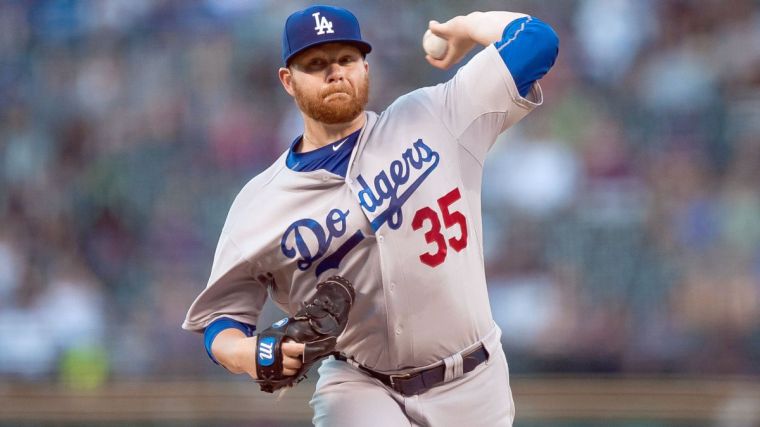
It was only about a week ago that almost every writer in the Los Angeles Dodgers‘ blogosphere expressed an opinion about Alex Wood and what type of role he would play in the upcoming season.

Now, with Brett Anderson having had back surgery and expected to miss three to five months, Wood has been quickly ushered to the fourth spot in the starting rotation, while the Dodgers are left scrambling to swiftly determine which pitcher slots into the fifth spot.

The popular opinion, at least among many of the Dodgers’ beat writers in attendance at Camelback Ranch, is that the best option is to lean towards one of the three players who have MLB experience — Mike Bolsinger, Carlos Frias or Brandon Beachy.

Depending on the overall spring training evaluations, Bolsinger could very easily be the safest choice of the trio, despite having several glaring inconsistencies.

In 2015, Bolsinger ended up contributing 109 innings over 21 starts for the Dodgers, compiling a 6-6 record with a 3.63 ERA, a 8.1 K/9, and a 3.91 FIP. For those unfamiliar with FIP (fielding independent pitching), it separates a pitcher’s performance from the ballpark and defense around him. Generally if a pitcher’s FIP is higher than his ERA, it usually means the ERA is on the upswing.

Indications also suggest that Bolsinger’s lack of velocity has a bearing on his performance when facing opposing hitters the second and third times through the batting order. Not that a pitcher with a lower velocity can’t have success, but somebody with an average fastball of 89.2 mph and a slider floating in at 80.6 mph who can’t precisely hit his spots makes it much easier for the opposition to succeed.

Frias, on the other hand, has an electric arm and a very high ceiling based on his velocity alone. He made 17 appearances, including 13 starts, for the Dodgers last season, hurling 77.2 innings to a tune of a 4.06 ERA.

The knock on Frias is that the separation of speeds between his hard stuff and his breaking pitches is so small, that it allows opposing batters to make better reads. Last year, for example, both his fastball and sinker averaged in the 97-98 mph range, while his changeup averaged 91.8 mph. Until Frias can develop and command a more effective arsenal of breaking pitches, he may be better suited for the bullpen.

There’s really not much recent data to make a fair assessment of Beachy. After returning from Tommy John surgery last season, he pitched 47 innings over 10 appearances at Oklahoma City. When given the opportunity with the Dodgers, he surrendered 10 hits and seven earned runs in the two games he started.

One concern with Beachy is that he altered the mechanics of his delivery to avoid additional problems with his elbow. In his old delivery, he threw across his body to generate better spin, whereas now he throws more in a straight line towards the dish with less rotation. Whether this proves to be beneficial and effective in the long run remains to be seen.

While the safe bet may be to ride the shoulders of one of the aforementioned pitchers, the brain trust here at TBPC believes that one of the second-tier options — José De León, Zach Lee or Jharel Cotton may be the better alternative.

De León’s fastball, which has nasty, late movement and sits in the 93-96 MPH range, is by far his best weapon. His slider rates a little above-average but continues to improve. His changeup is by far his best off-speed pitch — he’s not afraid to use it when behind in the count and often uses it as his strikeout pitch. He’s considered to be MLB-ready and possesses the most raw talent of the three.

In terms of mental makeup, Lee is probably the most mature prospect in the organization. His command is very sharp, which was made evident by his 1.5 BB/9 last season. His sinker is consistently solid, resulting in a 50% ground ball rate. His slider is still developing, which will eventually compliment his four-seamer, changeup and sinker. Lee still shows plenty of velocity with the heater, having the ability to reach up to 94 mph.

Cotton probably has the best changeup in the Dodgers’ entire system, and projects much better as a starter after a short stint as a reliever in Triple-A last season. His fastball is still somewhat of an enigma, sitting in the mid-90s at times then sitting 90-91 other times . His breaking pitches are his best weapons, leading him to a 10.7 K/9 in almost 100 innings of work last year.

Of course, any rookie could have the finest skills on the diamond, but ultimately head downhill when given a shot in the bigs. Psychological fortitude is critical at the major league level — having the ability to see past a rough outing, having the mental endurance to stay strong the entire season and having the capacity to be coachable are just several attributes that are paramount for success.

While their performances on the field at spring training will have the most influence on who gets the eventual call to be the fifth starter, option years and 40-man roster implications aside, it very well could be time for one of the kids to step into the rotation and shine above the rest.

(Photo Credit: Dustin Bradford/Getty Images)

Projecting the Starting Rotation at Oklahoma City: Second Edition

Jose-De-Leon

When we last explored the projected starting rotation at Oklahoma City in December, the Dodgers’ big league rotation was trending towards being on the thin side, while the Triple-A rotation looked to be crowded. Now, with spring training upon us, things seem to have leveled out a bit.

Since our last analysis, the Dodgers bolstered their starting rotation by adding veteran lefty Scott Kazmir, as well as Japanese righty Kenta Maeda. Brandon Beachy was also brought back on another one-year contract, hoping to create depth for a rotation that currently projects to include four left-handed starters and one right-hander.

The Yasiel Sierra signing finally became official; and although he projects to be a potential middle-reliever in the bigs early in his career, he may see time as a starting pitcher in the minors, at least in the beginning of the season.

Joe Blanton was signed to a one-year deal last month to be utilized as a long man in the bullpen, which may affect the role of Carlos Frias early in the year. Frankie Montas, who was projected to see some time as a starter in the minors, was moved to the 60-day disabled list after having rib resection surgery.

Finally, the trade that sent Joe Wieland to the Mariners on January 12 created space on the 40-man roster and provided a bit of breathing room for the rotation at OKC.

All that being said, here’s a list of the potential pitchers vying for a rotation spot in Oklahoma City in 2016. Also included are the pitchers’ ages come Opening Day, the number of option years they have remaining and a brief commentary as to where they may begin the season.

  • Brandon Beachy – 29 years, no options
  • Mike Bolsinger – 28 years, one option remaining
  • Carlos Frias – 26 years, one option remaining
  • Zach Lee – 24 years, two options remaining
  • Ross Stripling – 26 years, all three options remaining
  • Yaisel Sierra – 24 years, all three options remaining
  • Jharel Cotton – 24 years, all three options remaining
  • José De León – 23 years, all three options remaining
  • Julio Urias – 19 years, all three options remaining

Although José De León and Julio Urias are arguably the two most talented pitchers on the list, neither is on the 40-man roster, and may not see big league action until rosters expand in September. De León is fully developed and is considered by many to be MLB-ready, while Urias likely needs one additional season on an innings count due to the fact that he’s still maturing physically. Barring injury, both should hold down spots in the Oklahoma City rotation for the majority of the season.

Jharel Cotton had been a starter most of his career, but was given an opportunity to relieve late last season when the Triple-A bullpen was very thin. He probably has the best changeup in the Dodgers’ entire system, and projects better as a starter due to the lack of velocity on his fastball (90-91 MPH). His breaking pitches are his best weapons, leading him to a 10.7 K/9 in almost 100 innings of work last year. Still, with the rotation being as crowded as it is and the bullpen on the thin side, Cotton may begin the season as a reliever.

Beachy and Mike Bolsinger will certainly be the first two to be called upon if the Dodgers need help. After returning from Tommy John last season, Beachy pitched 47 innings over 10 appearances at OKC. When given the opportunity in the bigs, he surrendered 10 hits and seven runs in two appearances. Bolsinger ended up contributing 109 innings over 21 starts for the Dodgers, compiling a 6-6 record with a 3.63 ERA and a 8.1 K/9. Both project to be the front-line starters for Oklahoma City.

Former first-round draft pick Zach Lee had a rough debut for the Dodgers against the Mets last July, but put up solid numbers in Triple-A over the course of the season. He compiled a 11-6 record while throwing 113 innings over 19 starts, which led to a 2.70 ERA and a 1.11 WHIP. He also likely fills a starting slot for OKC.

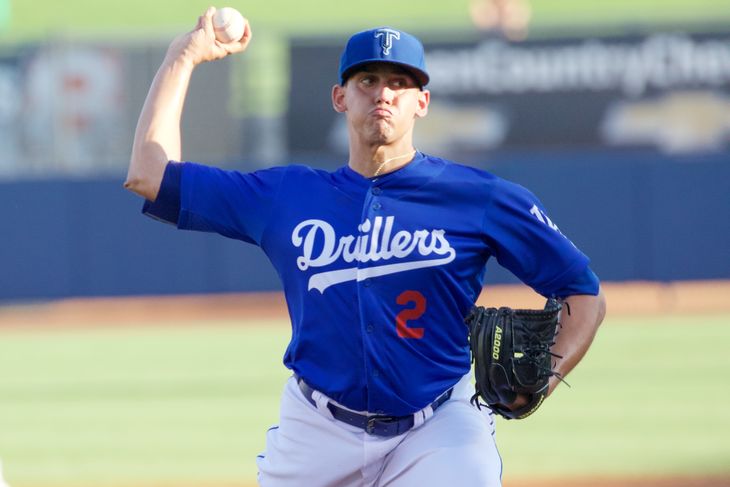
Ross Stripling returned from Tommy John and pitched 67 innings over 13 starts for the Tulsa Drillers last season. He was added to the 40-man in November to protect him from Rule 5 status. Stripling isn’t overpowering, but features a nasty arsenal of breaking pitches much like Bolsinger. Stripling has never thrown at the Triple-A level, and may begin the year at Tulsa just to make room for everyone else at Oklahoma City.

While considered to be MLB-ready by most scouts, the prudent avenue for Sierra would be to begin the year in the minors, if only for reasons of getting acclimated to his new country. Over five seasons in Cuba’s Serie Nacional, he went 16-21 with 25 saves and a 4.23 ERA in 131 games which included 25 starts. Sierra most likely starts the season at Tulsa.

Frias made 17 appearances including 13 starts for the Dodgers last season, hurling 77.2 innings to a tune of a 4.06 ERA. Blanton may command the role of long man early in the year for the Dodgers, but depending on the health and effectiveness of the remainder of the relief corps, Frias should see big league action at some point in 2016. As for the beginning of the season, he most likely gets the nod as long man and/or spot starter for OKC.

Depending on the health and progression of lefty starter Hyun-jin Ryu at the beginning of the season, Alex Wood could see time in the minors if the Dodgers’ rotation stays healthy, only because he’s one of the few that has options remaining on his contract. We do have a few ideas how this may play out, however; and we’ll be providing additional insight and commentary later in the week.

In light of everything discussed, we see things at Oklahoma City shaping up something like this:

  • OKC starting rotation: Beachy, Bolsinger, Lee, De León and Urias; with both Frias and Cotton in the bullpen
  • Stripling and Sierra beginning the year at Double-A Tulsa but rising quickly

If healthy, the 2016 Triple-A rotation may very well be the deepest and most talented that Dodger fans have seen in many, many years. Beyond that, the next wave of talent is beginning to blossom and shine in Single-A and rookie ball.

Right now, the Dodgers’ future seems to be extremely bright — at least on the pitching front.

(Photo Credit: Rich Crimi/Tulsa Drillers)