Continuing along with our winter profiles of a few select members of the Dodgers‘ coaching and management crew, today we cruise down to the Triple-A level, where we take a quick look at Oklahoma City manager Bill Haselman.
During the dullest days of the break last winter, we took a few moments to profile a few members of the Dodgers management team, most specifically GM Farhan Zaidi and new additions to the coaching staff in George Lombard and Bob Geren. This year, traveling higher up on the totem pole, we decided to take a closer look at president of baseball operations Andrew Friedman mainly for the sake of having a solid reference link, but also in an effort to learn more about the primary decision maker of the Los Angeles front office crew.
Los Angeles Dodgers shortstop Corey Seager, left, is congratulated by manager Dave Roberts after hitting a solo home run during the seventh inning of a baseball game against the St. Louis Cardinals in Los Angeles. (AP Photo/Mark J. Terrill)
Thanks to two timely awards handed out by the Sporting News and a few motivating words delivered by boss Andrew Friedman on Monday, any lingering feelings of disappointment among Dodgers fans from the NLCS defeat almost fizzled completely, welcoming a positive wave of optimism as the winter months roll in.
Los Angeles Dodgers manager Don Mattingly talks to general manager Ned Colletti during a spring training baseball workout Wednesday, Feb. 23, 2011, in Glendale, Ariz. (AP Photo/Morry Gash)
(Photo Credit: Hans Gutknecht)
While the Los Angeles Dodgers decided to embark on a brand new front office structure during the winter of 2014, the game of baseball itself was experiencing an evolution of sorts, as the national pastime began morphing into a game of numbers, analytics and financial management as opposed to seeing the most dominant clubs succeed with intangible qualities like grit, wit and desire.
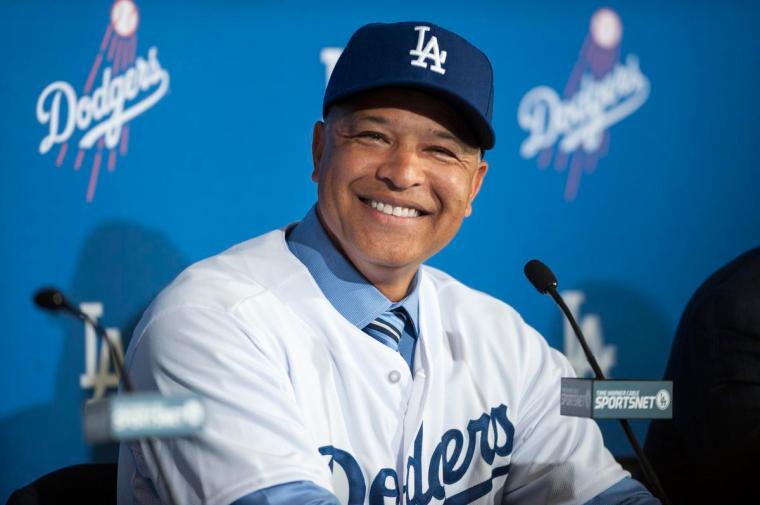
When Dave Roberts exited the room after his initial managerial interview in Los Angeles last November, members of the Dodgers‘ front office knew immediately they had their man.
“Everyone was blown away by who he is, what he represents. You can see his energy, you can see the enthusiasm, and his ability to connect with people,” Andrew Friedman said.
“There’s a positivity and energy to Dave that really is the overriding thing in any conversation you have with him,” Farhan Zaidi added. “You can feel it in any room that he’s in.”
Today, fully entrenched in the daily operations of spring training, Roberts is creating a new type of energy among the players — employing creative team building exercises with total player involvement and even going as far as utilizing cutting edge neurological technology.
Bill Plunkett of The OC Register was among the first to report the Dodgers’ application of “NeuroScouting,” which, according to outfielder Scott Van Slyke, “is the science of improving your performance in terms of reaction and recognition.”
“I think it’s certainly about being open-minded (as an organization). In this day and age, there’s a lot of research and time spent on various technologies. We vet it very thoroughly on the front end and introduce different things to our players with what we’ve learned and make it something that’s available to our guys if they want to try it,” Friedman said.
As far as the teamwork-type of activities, Plunkett cited several examples which involved numerous players having to to plot the hometown of all their coaches and teammates on a map, as well as one player, Cody Bellinger, needing to chronicle his attempts to reach 10,000 Twitter followers by the end of spring training.
Bellinger even went as far as preparing a fundraising chart which documented his progress. Many of Bellinger’s teammates and coaches reached out to their own audiences on Twitter to help the cause:
@Cody_Bellinger Chicks did the long ball and # Cody Love follow him on Twitter.
In addition, Roberts also held “Coffee with Doc” sessions where players had isolated meetings with Roberts and other members of the training staff, coaching staff and front office, giving all the new members of the organization an opportunity to become familiar with one another.
“I got a lot of it from Buddy Black (ex-Padres manager) and I think he learned it from (Angels manager Mike) Scioscia. There are certain things you take from everybody that you like and some that you don’t and that don’t make sense, but that is one of those things I really enjoyed,” Roberts said.
In light of all of Roberts’ efforts, the squad seems to be heading in a new direction in terms of chemistry — something that former manager Don Mattingly, with his laid-back and unruffled approach, was often criticized for not working harder to attain.
Regardless, while all the synergistic games and team building exercises may be great for boosting morale in camp, they don’t necessarily translate to wins on the baseball field.
Ultimately, the manager can only do so much, as it’s up to the players to perform and orchestrate the victories on the diamond.
However, if the squad embraces even a small portion of the energy, knowledge and experience that Roberts is exuding, 2016 could turn out to be a very special season.
Corey Seager takes batting practice at Petco Park.
Ned Colletti. See? Two words in and you, as a Dodgers fan, are feeling some type of way. The Dodgers under Colletti spent lavishly, made blockbuster trades, and threw their financial muster around at anyone and anything that would receive great public approval. How many World Series titles did the Dodgers claim? Oh that’s right. None. They didn’t even reach the World Series. While the Dodgers were spinning their wheels, Andrew Friedman and the Rays were popping bottles after 162 games.
The 2010 Dodgers roster featured names like Clayton Kershaw, Hiroki Kuroda, Vicente Padilla (and the surprising success of the soap bubble), Russell Martin, Casey Blake, Rafael Furcal, Garret Anderson, Matt Kemp (in his prime), and Manny Ramirez. Many of those names were considered premier talent in the league. Where did that team finish? 80-82, fourth place in the National League West.
The 2011 and 2012 Dodgers campaigns also failed to make the playoffs.
While the Dodgers failed to make the playoffs in 2010 and 2011 with a payroll north of $100 million, the Tampa Bay Rays made the playoffs in both seasons with a payroll checking in around $77 million in both seasons.
Now why did I spend the first four paragraphs laying all this out? Not just to calm you down from mentioning that name at the beginning of this piece, but also to provide apparently desperately needed perspective as this offseason trudges along without blockbuster Dodgers news.
Hiring a President of Baseball Operations like Friedman was the writing on the wall for many educated baseball observers, signaling the beginning of the inevitable. The Dodgers simply couldn’t spend close to $300 million per season chasing after a World Series. The first two seasons under the new ownership were a showcase, a promise to Dodgers fans that their complaints are heard, and better things were awaiting in the ashes of a nasty divorce.
While Dodgers fans have watched one of the most star-studded free agent markets in recent memory with longing eyes, that sneaky front office went behind their backs, and slowly, methodically, built the farm system with shrewd trades.
This is a new type of Dodgers baseball, and not the type sports writers want to see because the Hollywood storylines are much harder to come by. However, the front office has set up the franchise for years of competitive, and downright cheap talent. Cubans like Yusniel Diaz, Omar Estevez, and Pablo Millan Fernandez are cheap compared to the average Major League Baseball big name free agent, and the youth in farm system has astronomical, controllable potential. For example, Joc Pederson won’t even be eligible for arbitration until 2018 (according to Spotrac.com). Prized pitching prospect Julio Urias, Jose de Leon, 2016 projected starting shortstop Corey Seager, and Puig all have years of control remaining on their contracts, with very high ceilings.
Signing the likes of David Price, Jordan Zimmerman, Johnny Cueto, and yeah even Zack Greinke would have only blocked the talent that is soon to be contributing at the Major League level. A 3-year deal for Scott Kazmir and an 8-year, incentive laden deal for Kenta Maeda are brilliant moves to mitigate overall cost while providing flex and trade value.
Don Mattingly is gone, fittingly to a team with its own set of problems. New manager (Dave Roberts), new look, same Dodgers success.
Patience. The agony of a boring offseason will be worth all the postseason glory. The Dodgers will make the 2016 MLB playoffs, and you’ll be right there, cheering them on. Think Blue Planning Committee will be cheering them on too, in between diving into your January Facebook posts to make fun of you for crying now and high-fiving in October.
All “organic” dialogues aside, there are very few general managers in MLB with more intellect, potential and industrial savvy than Farhan Zaidi. His education alone speaks volumes — a bachelors from MIT and a PhD from Cal-Berkeley.
Being of Pakistani descent, Zaidi was actually born in Canada. He moved to the Philippines at the age of four, where he remained until departing for college in 1994. He played baseball at the little-league and high school levels, but never took the field beyond that — similar to one of his mentors and predecessors, Paul DePodesta.
While at Berkeley, Zaidi read the book Moneyballand his career path began to take shape almost immediately. Admittedly, he often scanned through the employment ads on mlb.com while in grad school, and upon discovering an opening with the Oakland Athletics in 2004, couldn’t help but reach out.
He was hired immediately by GM Billy Beane, and began his career as a data analysis sabermetrics assistant. He eventually worked his way up to Director of Baseball Operations, then was promoted to Assistant GM in 2014. After the 2014 season, he was recruited by Dodgers President of Baseball Operations Andrew Friedman to assume the general manager role, becoming the first Muslim general manager of any American pro sports franchise.
Working beside both Friedman and VP of Baseball Operations Josh Byrnes, many Dodger fans actually wonder how the daily grind is delegated to Zaidi and “who does what” inside the All-Star think tank.
While Byrnes is primarily responsible for player development (overseeing such executives as Gabe Kapler), Zaidi is more in tune to the daily operations of the MLB squad, research and development, and player acquisitions.
With his education and 12-year background at the MLB level, Zaidi certainly fits the new model of today’s general manager. He has already developed a reputation for having blends of both old school and new school thought processes, unlike several of the dinosaurs before him in Los Angeles.
He believes in the “value” of a trade, and is very analytical in terms of giving up prospects of worth, possessing a similar philosophy to his bosses, Friedman and Stan Kasten.
Alongside Friedman, Zaidi continues to spend a great deal of time on R & D— developing new tools which measure every single split-second of players actions and reactions while on the diamond.
After a year at the helm, it’s certainly fair to say that the Dodgers are headed in a new direction—continuing to emphasize the farm and the value of youth, despite the overwhelming anxiety and desire of the fan base to win a World Series Championship “right now”.
Many of the skeptics are quick to point out that Zaidi’s lack of playing experience beyond high school may hinder is ability, while others are already bringing up bad player deals, especially whenever Dee Gordon wins any type of league award or honor.
The current system in place is definitely suited to win championships and build dynasties down the road. But with ticket and parking prices increasing annually, being the second-largest market in baseball and a $8 billion television deal that leaves many unable to view the majority of the games, the fans expect more than just development.
Twenty-seven years have now passed since the Los Angeles Dodgers have won a championship. Friedman and Zaidi are certainly qualified to break that streak, but the question that now lingers is whether that championship will come soon enough before ownership—just like the fan base—runs out of patience.




 Think Blue Planning Committee